
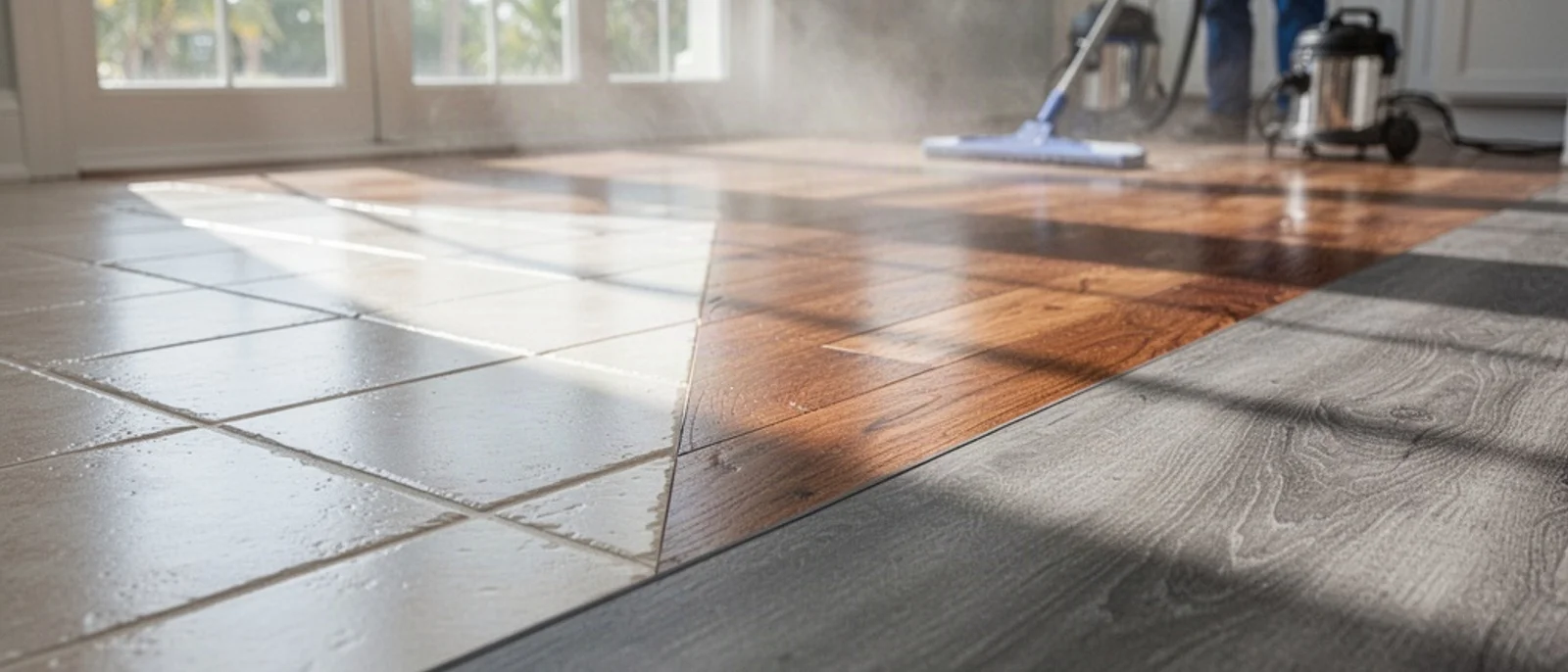
Florida floors face conditions that most national cleaning guides do not account for. Gainesville's combination of humidity, sandy soil tracking, and seasonal rain creates specific problems for each floor type — and specific solutions that differ from what works in dry climates.
Tile and grout in Florida homes
Tile is the most common flooring in Gainesville homes because it handles humidity well and stays cool underfoot. The tile itself is nearly indestructible. The grout is not.
Grout is porous. In a humid environment, it absorbs moisture from the air and from mopping. Over time, that moisture feeds mildew growth — the dark discoloration that appears in bathroom grout first and gradually spreads to kitchens and hallways. Standard mopping does not address this because a mop passes over grout lines without the mechanical action or dwell time needed to lift embedded growth.
Professional floor cleaning for tile involves grout scrubbing with a stiff brush and an alkaline cleaner, followed by a peroxide-based treatment that brightens without bleaching. For badly stained grout, a steam extraction pass lifts what chemical cleaning alone cannot. The result is visibly dramatic — most people forget what their grout color originally was until it is cleaned properly.
Get a floor cleaning quote → · Call 352-663-5924
Maintenance between professional visits: Sweep or vacuum daily in high-traffic areas. Mop with a pH-neutral cleaner (not vinegar — the acid etches grout sealant over time). Dry-mop after wet-mopping in bathrooms to prevent standing moisture in grout lines.
Hardwood floors and humidity
Hardwood in Gainesville requires respect for moisture that hardwood in Denver does not. Wood expands and contracts with humidity changes, and Florida provides both extremes: high ambient humidity in summer, followed by aggressive AC dehumidification that can swing a home from 75% to 40% relative humidity between indoors and outdoors.
That expansion-contraction cycle manifests as cupping (edges rising), crowning (center rising), or gaps between boards. These are not cleaning problems per se, but improper cleaning accelerates them. Specifically: excess water. A soaking-wet mop on hardwood in a Florida summer is working against you.
The correct approach: damp-mop only. Wring your mop or microfiber pad until it is barely damp, not dripping. Use a hardwood-specific pH-neutral cleaner. Never steam-clean hardwood — the combination of heat and moisture can delaminate the finish.
What professional floor cleaning adds: We use commercial microfiber systems designed for hardwood — flat mop heads with controlled moisture that clean without saturating. For periodic maintenance, a screen-and-recoat (light abrasion followed by a fresh coat of polyurethane) extends the life of your finish by years without a full refinish.
Luxury vinyl plank: what not to use
LVP (luxury vinyl plank) has become the most popular new flooring in Gainesville renovations because it looks like hardwood, handles humidity better, and costs less. But it has cleaning vulnerabilities that the "indestructible" marketing understates.
Do not use: Wax-based cleaners (builds up and clouds the surface), abrasive scrub pads (scratches the wear layer), steam mops (can delaminate the planks or weaken adhesive), ammonia-based cleaners (dulls the finish over time), or excessive water (seeps into seams on floating installations).
Do use: pH-neutral vinyl floor cleaner, microfiber flat mop with controlled moisture, and gentle agitation for scuff marks. LVP is forgiving of dirt — it is not forgiving of the wrong products.
Professional cleaning for LVP focuses on the seams and transitions where dirt accumulates and on removing the haze that builds up from product residue over months of DIY mopping with the wrong cleaner.
Contact us for a floor assessment → · Call 352-663-5924
How often floors need deep cleaning
The answer varies by floor type and traffic:
- Tile with grout: Every 3–6 months for grout detail work. Higher frequency in bathrooms.
- Hardwood: Every 6–12 months for a professional clean-and-condition. A screen-and-recoat every 2–3 years.
- LVP: Every 4–6 months for a professional strip of buildup and residue-free clean.
Between professional visits, daily sweeping and weekly mopping handle most of the work. The professional interval addresses what daily maintenance misses — particularly embedded soil, grout staining, and product buildup that dulls surfaces so gradually you stop noticing until a clean section reveals the contrast.
When to call someone in
You can maintain floors between professional visits without difficulty. Call us when:
- Grout is discolored and mopping does not improve it
- Hardwood has a haze or film despite regular cleaning
- LVP looks dull or feels sticky after mopping
- You are preparing to sell or host and floors need to look their best
- A renovation, flood, or extended vacancy left floors in a state beyond regular maintenance
Our floor cleaning service is surface-specific — we match products and methods to your exact floor type rather than using a single approach on everything. That specificity is what separates professional results from "I mopped and it still looks dull."
Ready for Professional Floor Care?
Contact us for a quote or call 352-663-5924. Floor cleaning is quoted per job based on floor type, area, and condition.
We also offer recurring residential cleaning that maintains floors between deep-clean sessions, and full deep cleaning that includes floor care alongside everything else.
Ready for a spotless space?
Book a visit and see why Gainesville trusts Doctor Sterile.